
Over the past 20 years, the rate of obesity has risen to alarming levels. It now affects approximately 40% of American adults.1
see the resourcesOver the past 20 years, the rate of obesity has risen to alarming levels. It now affects approximately 40% of American adults.1 That has to change. And that’s why we want to help providers who are on the front lines battling epidemics such as obesity and type 2 diabetes. Together — and armed with information, education and awareness — we can make a difference.
see how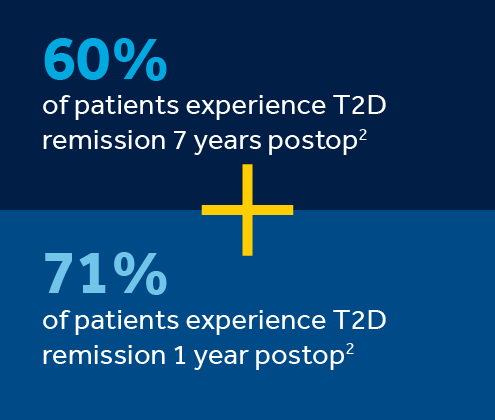
Diabetes and obesity often go hand-in-hand. The good news? Mounting medical evidence points to metabolic surgery as an effective treatment for both.3,4
see the data
Expected weight loss in one year
of overall body weight
Expected weight loss in one year
of overall body weight
Expected weight loss in one year
of overall body weight
Patients in general have a hard time talking about their weight. It’s even more difficult for those with obesity. Open the discussion in a respectful and nonjudgmental way – it’s the first step to helping them improve their health. Start a conversation of possibilities. And if you have trouble engaging your patients, encourage them to talk to a bariatric surgeon or bariatrician.
can we talkREFERENCES:
1. Hales CM, Carroll MD, Fryar CD, Ogden CL. Prevalence of obesity among adults and youth: United States, 2015–2016. National Center for Health Statistics Data Brief. 2017;288.
2. Courcoulas AP, King WC, Belle SH, Berk P, et al. Seven-Year Weight Trajectories and Health Outcomes in the Longitudinal Assessment of Bariatric Surgery (LABS) Study. JAMA Surg. 2018; 153: 427-434. doi:10.1001/jamasurg.2017.5025. PMID:29214306.
3. Sjostrom LLA, Peltonen M et al. Lifestyle, diabetes, and cardiovascular risk factors10 years after bariatric surgery. NEJM. 2004;351:2683–93.
4. Buchwald H, Estok R, Fahrbach K, et al. Weight and type 2 diabetes after bariatric surgery: systematic review and meta‐analysis. Am J Med. 2009;122:248–56.
5. Sumithran P and Proietto J. The defence of body weight: a physiological basis for weight regain after weight loss. Clin Sci 2103; 124: 231–41.
6. Pilitsi E, et al. Pharmacotherapy of obesity: Available medications and drugs under investigation. Metab Clin Exp 2019; 92: 170–92.
7. Lee PC, Dixon J. Pharmacotherapy for obesity. Aust Fam Phys. 2017; 46(7): 472–7.
8. NH&MRC (2013) Clinical practice guidelines for the management of overweight and obesity in adults, adolescents and children in Australia. Available at https://www.nhmrc.gov.au/about-us/publications/clinical-practice-guidelines-management-overweight-and-obesity#block-views-block-file-attachments-content-block-1, Accessed September 2019.
US-NA-2000207